

The third BluMach alpha, 0.1.0-alpha.3, is out. It brings new machines and fixes several things on the Olivetti PCS that had been wrong since the first release.
Like the previous ones, it’s experimental. A machine that boots isn’t necessarily a machine that works well, and each machine’s page notes what I’ve tested and what I haven’t.
Before you download: BluMach does not include ROMs, BIOS files or operating systems. You’ll have to obtain them yourself; they are not distributed with the program.
New machines
- Olivetti PCS 286/S, with a Texas Instruments board. It can be created at 12 MHz, presumably used as a replacement board for the PCS 286, or at 16 MHz, which matches the 1991 PCS 286S. The forms offer the brochure’s 40 MB disk or generic 80 and 120 MB disks, and the same sound cards as the PCS 286.
- Olivetti Prodest PC 1 and PC 1 HD, with an NEC V40; the HD with a 20 MB XTA disk.
- Olivetti M28, a 286 at 8 MHz with a 5.25-inch 1.2 MB floppy drive.
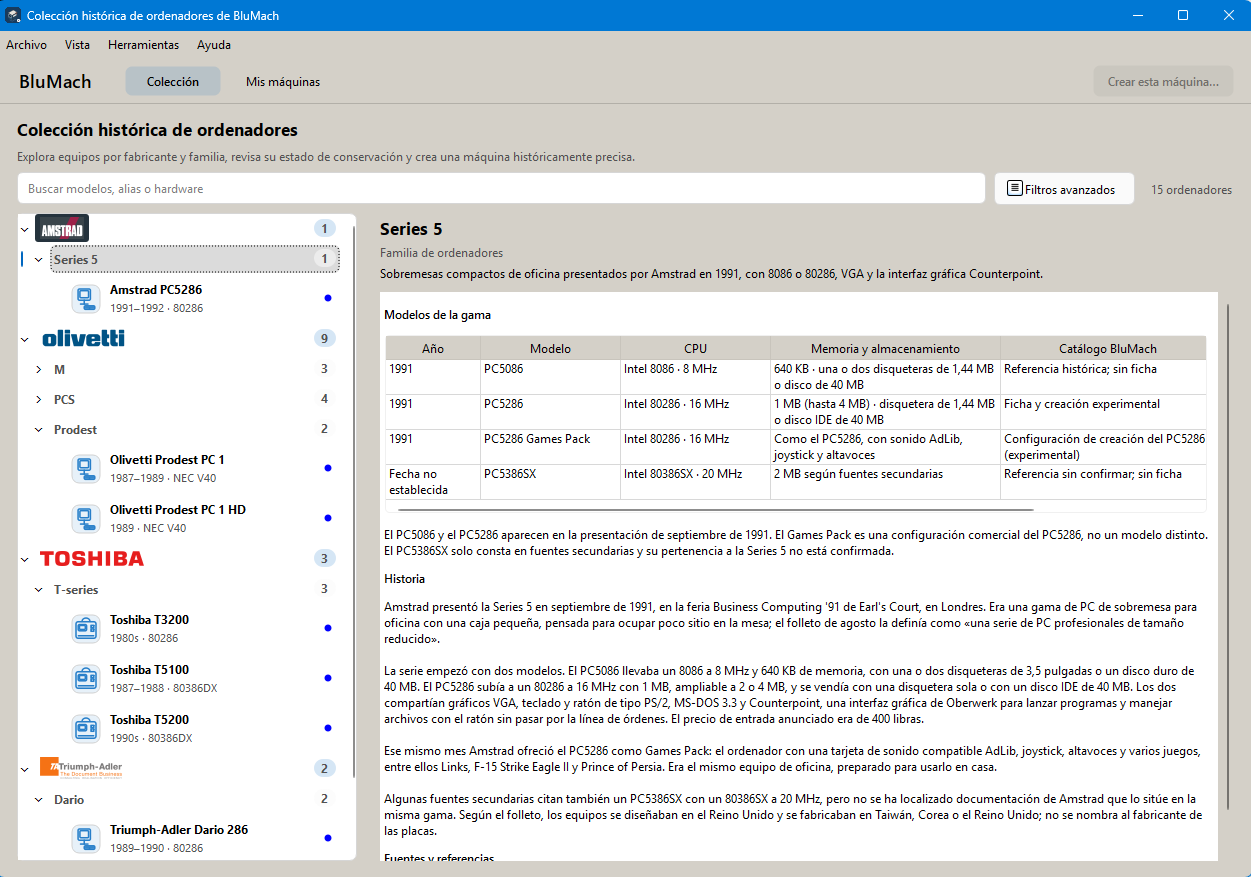
- Amstrad PC5286, a 286 at 16 MHz.
- Triumph-Adler Dario 286 and Dario 386SX. They use the same boards as the PCS 286 and PCS 386SX and were sold when Triumph-Adler belonged to Olivetti. It isn’t documented whether they were a Triumph-Adler design, an Olivetti commission or the same product under two brands.
Fixes on the PCS machines
What I found while going through the BIOSes is told in The speed that wasn’t. In short:
- On the PCS 286, PCS 286/S, PCS 386SX and Dario 286, the memory and I/O speed, the keyboard language and the Setup password are now kept across restarts.
- The chosen speed is applied: the expansion bus runs slower and slow memory is simulated approximately.
- On the PCS 386SX, drive B, the shadow RAM and the EMS memory split no longer go back to their defaults at boot.
- On the PCS 286, drive B can be selected if the virtual machine has two floppy drives.
And on the PCS 86, the GOFAST and GOSLOW utilities now change the speed, between 10 and 7.2 MHz, and Check-It finishes without hanging with the 8087. I wrote about it in My PCS 86 against BluMach.
Catalogue
Brands now appear in alphabetical order. The family pages for the Amstrad Series 5 and the Triumph-Adler Dario finally have their history and a table of models: the Series 5 with the PC5086, the PC5286 and its Games Pack, and the Darios with their Olivetti equivalent.
What has been checked and what hasn’t
“Checked” means I’ve seen it work myself, not that the emulation is exact. The automated tests and the Windows, Linux and macOS builds have passed, but I haven’t gone through every new machine by hand.
| Machine | Checked | Pending |
|---|---|---|
| PCS 286/S | BIOS 2.06 at 12 and 16 MHz, the Setup and its speed option, and 4 MB of memory | The profiles with 80 and 120 MB disks |
| Prodest PC 1 | Nothing yet with this release | Cold reset, keyboard, reading and writing floppies, and display |
| Prodest PC 1 HD | Nothing yet with this release | Installing and booting from the XTA disk, and reset |
| M28 | Nothing yet with this release | Type 2 disk in the CMOS, installation, booting from the disk and Ctrl+Alt+Del |
| PC5286 | Nothing yet with this release | MS-DOS boot, installation on disk and the Setup being saved |
| Dario 286 | Uses the same board and BIOS as the PCS 286, which has been tested | Booting with its own profile |
| Dario 386SX | Its BIOS has the same code as the PCS 386SX's, which has been tested | Booting with its own profile |
Download
The release is on the alpha.3 page on GitHub, for 64-bit Windows only. Unzip it into a new folder and open BluMach.exe. The release guide explains the installation, the firmware each machine asks for and the known limitations.
If something fails, open an issue on GitHub with the version, the machine, the BIOS, the memory, the disk and the steps to reproduce it.