

Olivetti · PCS
Olivetti PCS 286/S (TI/OLIMCU16, 12/16 MHz)
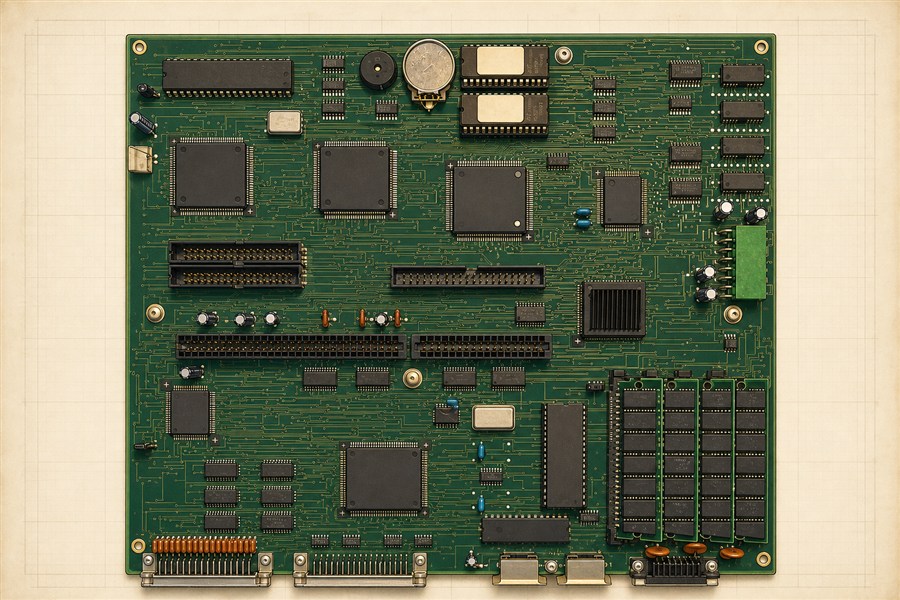
1991 TI/OLIMCU16 board at 12 or 16 MHz, bootable with Olivetti BIOS 2.06; possibly the board of the commercial PCS 286S.
IDENTITY UNRESOLVED: BluMach reproduces and boots this TI/OLIMCU16 board with its original BIOS 2.06. POST, video, keyboard, the real-time clock, the 40 MB IDE disk and 1, 2 and 4 MB of memory have been checked. EMS memory is still missing.
History
This board uses the TI TACT82300 family, Olivetti's OLIMCU16 ASIC, a PC87310 and integrated Paradise video. A 2021 preservation thread suggested that it served as a replacement board for failed PCS 286 systems and in PCS 286S machines. A surviving PCS 286S uses the same TI TACT82300 family, so this board is possibly also the one in the 1991 commercial model. Its EPROMs are labelled "PCS286S REL. 1.06" and have not been dumped, so it is unknown whether they match the known BIOS 2.06. A 1991 Olivetti brochure documents a zero-wait-state 16 MHz 80286, 1 MB standard RAM, up to 8 MB on the system board, 16 MB in the system and 40, 80 or 120 MB disks. In BluMach that model is created from this sheet by choosing 16 MHz, experimentally and with BIOS 2.06.
Hardware
- Processor
- Intel 80286 at 12 MHz (validated) or 16 MHz (experimental, as in the commercial PCS 286S); BIOS RAM/IO frequencies 12/12, 12/6 and 6/6 MHz
- Memory
- 1, 2 and 4 MB validated on the TI/OLIMCU16 board. Experimental generic ISA/AT expansion profiles also boot with 8 and 16 MB total; they prove a workable emulation path, not the existence of a specific Olivetti expansion card
- Video
- Integrated VGA
- Floppy drive
- 3.5 in, 1.44 MB
- Chipset
- Texas Instruments TACT82300 family + Olivetti OLIMCU16 ASIC
- Clock and CMOS
- AT-compatible CMOS RTC with separate motherboard battery; exact chip unidentified
- Math coprocessor
- Intel 80287 optional
- Expansion slots
- 2 × 16-bit AT + 1 × 8-bit XT full-size slots
- Interfaces
- RS-232C, bidirectional parallel, mouse, AT keyboard
- Dimensions and weight
- 360 × 312 × 100 mm; 7.6 kg
Catalogue classification
- Form factor
- Desktop
- Mobility
- Stationary
- Processor generation
- 80286 class
- Graphics standard
- VGA
- Storage interface
- Floppy drive, IDE
Research
This page separates documented hardware facts, behavior observed in original firmware, and the current fidelity of BluMach emulation.
Architecture and memory
Evidence: documented or confirmed hardware
- CPU and bus
Intel 80286 at 12 MHz (validated in BluMach) or 16 MHz (experimental), selectable when creating the machine; the BIOS offers RAM and I/O frequencies of 12/12, 12/6 and 6/6 MHz; socket for an optional 80287 coprocessor.
- Memory
1, 2 and 4 MB are validated on the TI/OLIMCU16 board. Total 8 and 16 MB profiles also boot using a hypothetical generic ISA/AT card providing 4 or 12 MB from the 4 MB address. These profiles prove technical feasibility, not the existence of a specific Olivetti card.
- Storage
The brochure for the 16 MHz PCS 286S offers one 1.44 MB floppy and 40, 80 or 120 MB hard disks. BIOS 2.06 has been validated booting from a 40 MB CP346 (805 cylinders, 4 heads, 26 sectors); 80 and 120 MB remain pending.
BIOS and firmware
Evidence: current BluMach status; not necessarily a description of the original circuit
- Known revisions
Olivetti BIOS and Resident Diagnostics 2.06 dated 20 May 1991. Two 64 KiB EPROMs exactly reconstruct the 128 KiB FULL image; Setup supports English, Italian, German, French and Spanish.
- Video
BIOS 2.06 initializes the integrated Paradise VGA, which renders Resident Diagnostics and Extended Setup correctly; no external video ROM is required.
- CPU and bus
Extended Setup offers 12/12, 12/6 and 6/6 MHz as RAM and I/O frequencies, not CPU speeds: the BIOS stores them in CMOS byte 1Bh and programs them into TI chipset registers 08h and 09h, and never changes the processor clock, which is set by the board crystal. BluMach therefore lets you create the machine at 12 MHz, the checked speed, or at 16 MHz, the speed of the commercial PCS 286S, which is still experimental. In BluMach this option (F7) changes the I/O bus speed and, approximately, memory timing.
- Modeled interface
BIOS 2.06 probes 0208h, 0218h, 0258h, 0268h, 02A8h, 02B8h and 02E8h. It initially uses 0208h while sizing RAM, then relocates the interface to 0218h, with four 16 KB windows at base+0000h/+4000h/+8000h/+C000h. BluMach reproduces this renegotiation and the observed aliases; the exact TACT82300/OLIMCU16 division remains unresolved.
- Verified
Checked in BluMach, with documented limits: BIOS 2.06, POST, integrated Paradise VGA, RTC, keyboard—including the MS-DOS F3-reset-F2 sequence—boot from a 40 MB CP346 and 1, 2 and 4 MB of board memory. These checks were made at 12 MHz; the 16 MHz option has not been validated yet; 8 and 16 MB totals use a hypothetical ISA/AT expansion.
- Pending or approximate
EMS remains pending: HIMEM.SYS can manage XMS on the 80286, but EMM386 cannot run on a 286 and no OLIMCU- or Olivetti-card-specific EMS driver is preserved. BIOS 2.06 Setup offers no shadow, extended/expanded memory split or buzzer volume on this board, although their texts remain in the ROM; F7 is applied approximately to the I/O bus and memory timing. The 8/16 MB ISA profiles do not reproduce an identified historical card. The board photograph shows a separate battery and no identifiable Dallas module.
Sources
Sources and traceability
Evidence: primary sources and research notes