

Olivetti · PCS
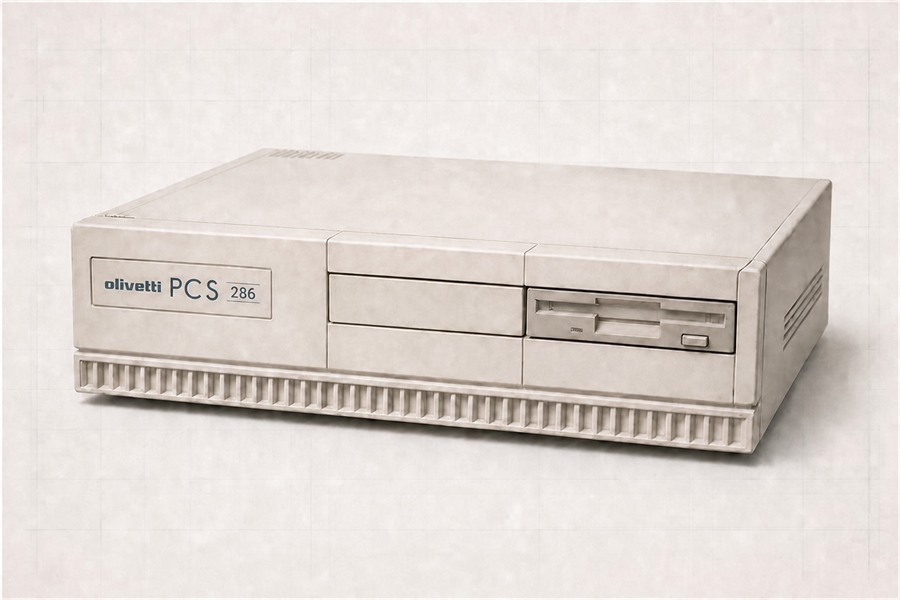
Olivetti PCS 286
12 MHz 80286 model with integrated VGA and IDE storage.
History
The PCS 286 occupied the middle position in the PCS line. BIOS revisions 1.37 and 1.42 are preserved; BluMach has validated POST, Extended Setup, MS-DOS boot and Customer Test with a 40 MB IDE disk. The keyboard controller's original internal ROM and some board-logic registers remain functional approximations.
Hardware
- Processor
- Intel 80286 12 MHz
- Memory
- 1 MB standard; up to 4 MB on-board and 16 MB system
- Video
- Paradise/Olivetti VGA integrated
- Floppy drive
- 3.5 in, 1.44 MB
- Clock and CMOS
- 128-byte AT-compatible CMOS RTC
- Math coprocessor
- Intel 80287 optional
- Expansion slots
- 2 × 16-bit AT + 1 × 8-bit XT full-size slots
- Interfaces
- RS-232C, bidirectional parallel, mouse, AT keyboard
- Dimensions and weight
- 360 × 312 × 100 mm; 7.6 kg
Catalogue classification
- Form factor
- Desktop
- Mobility
- Stationary
- Processor generation
- 80286 class
- Graphics standard
- VGA
- Storage interface
- Floppy drive, IDE
Research
This page separates documented hardware facts, behavior observed in original firmware, and the current fidelity of BluMach emulation.
Architecture and memory
Evidence: documented or confirmed hardware
- CPU and bus
Intel 80286 at 12 MHz with one wait state; AT-class platform with optional 80287 coprocessor.
- Memory
1 MB standard, expandable to 4 MB on the motherboard and 16 MB in the system. BIOS tests base and extended memory during POST.
- Storage
Integrated IDE/ATA. Documented configurations use two 1.44 MB floppy drives, or one floppy with a 20 MB Conner CP3022 or 40 MB CP346 hard disk.
Chipset and board logic
Evidence: manufacturer manual compared with the BluMach implementation
- Main circuits
G2 GC101A + GC102 set, later incorporated into the Headland family. BluMach uses 86Box's GC101/102/103 device plus Olivetti-specific IOC02 logic.
- Integrated functions
GC101 combines peripheral control, timing, arbitration and memory control; GC102 supplies address/data buffers and parity. The design supports up to 4 MB, matching the PCS 286 commercial limit.
- Modeled interface
The current model exposes 1ECh as EMS data, 1EDh as configuration index, 1EEh as EMS map index and 1EFh as configuration data. This is BluMach's functional interface and is not yet claimed as a complete physical decode of the motherboard.
- Original manual
GC101/GC102 Data Sheet, 55 pages, preserved inside BluMach
BIOS and firmware
Evidence: observed in preserved firmware and boot testing
- Known revisions
Sets 1.37 (one archival file was labelled 1.34) and 1.42. The 16 MHz PCS 286 S variant remains separate and is not presented as identical hardware.
- Configuration
Extended Setup (F1–F10) stores in CMOS the clock, hard disk (12h), floppy drives (10h), video (14h/1Ch), RAM test speed, RAM/IO frequency (12/12, 12/6 or 6/6 MHz: memory and I/O clocks, not the CPU clock), keyboard repeat rate, password and keyboard language. It has no shadow or EMS options. Drive B is offered only when the BIOS detects two floppy drives; with a hard disk only one internal drive fits, so the second would be external. In BluMach the frequency setting drives the I/O bus speed and, approximately, memory timing.
- Resident diagnostics
The observed Customer Test validates DMA controllers, keyboard, clock/calendar, protected mode and CMOS, and reports floppy, fixed-disk and configuration errors.
Findings from BIOS disassembly
Evidence: behavior recovered from BIOS code and testing
- ROM organization
128 KB BIOS at E0000h–FFFFFh. Revision 1.42 comes from two 64 KB 27C512 EPROMs, LOW and HIGH, byte-interleaved. The older set identifies itself as 1.37 although its archival label said 1.34.
- Memory-controller test
Test 6 writes the string RAM-REMAPPING at 60000h and checks whether it reappears at 80000h. The BIOS selects the DRAM configuration with bits 2, 4 and 7 of keyboard-controller port P2: it tries the 1 Mbit chip configuration first and, if the string is reflected, falls back to 256 Kbit. BluMach only reflects 60000h at 80000h with 1 MB fitted and while bit 7 is set. Until this version the alias was permanent: it took 128 KB of conventional memory and pushed 2 and 4 MB boards into the 256 Kbit configuration.
- Olivetti IOC02
Ports 68h, 6Ah and 6Ch. Phoenix 1.42 expects the first 6Ah read to publish 04h (subsystem ready). The device also resets on warm reset so stale values cannot cause I/O CONTROLLER ERROR 2.
- Keyboard POST
Routine at F000:D192. It sends FFh to the keyboard, receives FAh as ACK and then waits for AAh as BAT result. Keyboard Error 4 means exactly that FAh arrived but BAT did not finish before timeout; this finding allowed the sequence to be fixed without fabricating keystrokes.
- CMOS and BIOS data area
Phoenix compares the BDA equipment word at 0040:0010 with CMOS 14h. For 80x25, one floppy and no coprocessor the base value is 0020h. CMOS 0Eh holds diagnostic state and 10h the floppy type; checksum covers 10h–2Dh and is stored at 2Eh/2Fh.
- Video firmware
No valid 55 AAh option-ROM signature appears at C0000h. Historical halves named Video at E0000 and BIOS at F0000 are actually parts of system BIOS 1.37. Paradise/Olivetti initialization is integrated in the main ROM.
Emulation status
Evidence: current BluMach status; not necessarily a description of the original circuit
- Verified
BIOS 1.42, POST, Extended Setup, MS-DOS boot and Customer Test execution with a 40 MB IDE disk.
- Pending or approximate
The complete physical I/O decode, exact effect of some GC101A registers and authentic internal M5L8042-243P ROM remain to be documented. A functional approximation is used where no dump or schematic is available. The password keyboard-lock mode is not emulated, and the keyboard repeat rate follows the host computer.
Sources
Preserved research material
Evidence: primary sources and research notes
- Original product brochure
- PCS 286, Olivetti Office Italia product sheet dated October 1989, 2 pages
- Analyzed firmware
- BIOS 1.37 and 1.42, Resident Diagnostics, Customer Test and POST traces. Original EPROMs, normalized images and CMOS states are kept separately.
- Programmable logic
- PAL16L8 2P04 and 3P01 are preserved as JEDEC. The documented physical controller is a Mitsubishi M5L8042-243P; its authentic internal ROM has not been recovered. 62410C62.BIN is not that ROM and is not loaded into the 8042.