

Olivetti · M
Olivetti M10
1983 8-bit portable with an 80C85, battery-backed RAM, resident BASIC and a 240 × 64 LCD. It runs on the CoreMach engine.
EXPERIMENTAL: needs a BluMach build with CoreMach and the local 32 KB system ROM in roms/machines/olivetti_m10/. The bar-code reader, the modem and the low-battery warning are not emulated. Options are chosen when the machine is created; Settings does not change them.
History
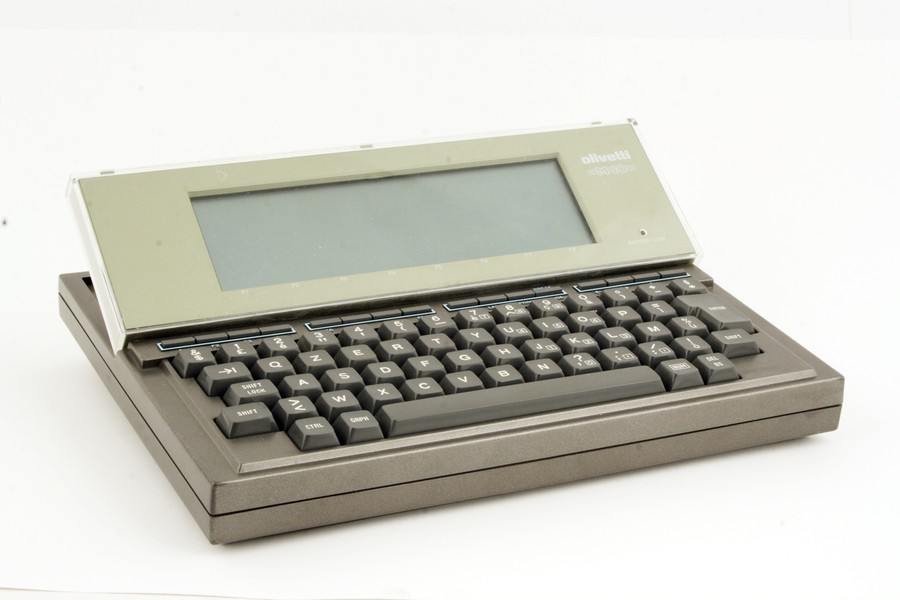
Olivetti introduced the M10 in 1983 as a personal tool that fitted in a briefcase: it ran on four AA cells, kept programs and text in 8 to 32 KB of battery-backed RAM and carried in ROM a menu with an address book, text editor, communications and Microsoft BASIC. The design is credited to Perry A. King and Antonio Macchi Cassia. It is not IBM PC compatible: the processor is an 8-bit OKI 80C85, the display a tilting 240 × 64 dot LCD, and external storage was cassette.
It was built by Kyocera, which also made the Tandy TRS-80 Model 100 and a version for NEC, probably the PC-8201; MAME treats it as a variant of the Kyotronic 85. They share an origin but not an identity: case, board, keyboard, character set and ROM differ. MCmicrocomputer compared it with the Model 100 in February 1984. The European M10, without modem, came with Italian, French, German or British keyboards; the US M10 MODEM had a 300 bit/s modem and a ROM of its own that has not been preserved.
In BluMach, the M10 board is written for the CoreMach engine from the service manual and runs in its own window.
Hardware
- Processor
- OKI MSM80C85A at 2.4576 MHz (4.9152 MHz crystal)
- Memory
- 8, 16, 24 or 32 KB battery-backed RAM in 8 KB modules; 32 KB system ROM
- Video
- Tilting 240 × 64 dot LCD, 40 × 8 characters, ten HD44102 drivers
- Clock
- NEC uPD1990AC calendar clock, running while switched off
- Interfaces
- RS-232C (IM6402), Centronics parallel, cassette with remote motor control, bar-code reader, 40-pin system bus
- Keyboard
- 73 keys; Italian, French, German or British layout by jumpers
- Sound
- Buzzer driven by the 81C55 timer
- Power
- Four AA cells or 6 V DC; automatic power-off after 10 idle minutes
Catalogue classification
- Form factor
- Laptop
- Mobility
- Portable
- Display technology
- LCD
- Display colour
- Monochrome
Research
This page separates documented hardware facts, behavior observed in original firmware, and the current fidelity of BluMach emulation.
Architecture and memory
Evidence: documented or confirmed hardware
- CPU and bus
OKI MSM80C85A, 8085 compatible, at 2.4576 MHz (CLK from a 4.9152 MHz crystal). 8-bit data bus multiplexed with the low address byte; there is no PC interrupt controller, DMA or keyboard controller.
- Memory
32 KB system ROM at 0000h-7FFFh; RAM from FFFFh downwards in 8 KB modules (E000h, C000h, A000h, 8000h). An optional 32 KB ROM bank shares the same window and is not emulated. Empty addresses read FFh (assumption).
- Video
240 × 64 dot LCD, 40 columns by 8 lines, with ten HD44102 drivers selected from the 81C55 at F0h-FFh. BluMach shows it at integer scales with optional dot grid, shadow and contrast; colours are approximate.
- Keyboard and mouse
73 keys in a nine-row matrix with one diode per key, scanned by the 81C55 and read at E0h-EFh. Host keys map by position; CAPS LOCK latches like the original mechanism.
- Serial and parallel
RS-232C through an IM6402 at C0h-DFh clocked by the 81C55 timer; Centronics with data on port A, STROBE on E0h bit 1 and BUSY on PC2; cassette through SOD and SID with the motor on E0h bit 3; buzzer through PB5 and the timer.
- Clock and NVRAM
NEC uPD1990AC: time keeps running while the machine is off; its TP output drives RST 7.5 every 3.9 ms. BluMach keeps the clock and RAM in state/ in the machine folder.
- Jumper bank
Jumpers J1-J4 select the keyboard language and are read on 81C55 PC4-PC5: Italian, French, German or British. They are chosen when the machine is created.
- Analyzed firmware
First 32 KB of a local dump, with the CRC32 F0E8447A and SHA-1 that MAME declares for m10rom.m12. A VirtualT copy differs in two bytes, consistent with a century patch; it is not used. The ROM is not distributed.
Emulation status
Evidence: current BluMach status; not necessarily a description of the original circuit
- Implementation lineage
CoreMach board model written from the service manual, the Kyocera schematic and each chip’s data sheet. MAME was consulted only as a secondary source for the order of the LCD drivers, the UART bits and the SLCT pin; none of its code is used. A public engineering note is available in English.
- Screen controls
The contrast knob on the right side panel is reproduced in View › Contrast. Action gathers pause, reset, switching on after the automatic power-off, sound, serial port, cassette and printer.
- Verified
With the real ROM: menu and BASIC with the bytes free the guide gives for 8, 16, 24 and 32 KB; RAM and clock across sessions; power-off after ten idle minutes; BEEP and SOUND; SAVE and LOAD through “COM:” at 9600 bit/s; CSAVE and CLOAD on tape, including an 11025 Hz WAV; and LPRINT and LLIST.
- Pending or approximate
Timing is computed per instruction, not per bus cycle. The serial port works per character, without BREAK or RTS, DTR and CTS. The signal to tape is a square wave. SLCT on PC1 and the tape thresholds are assumptions. A tape recorded on a real M10 and the BEEP tone against the machine remain to be checked.
Engineering
This public engineering narrative explains how the evidence became an emulator implementation, including failures, compromises, validation and replacement criteria.
Sources
Sources and traceability
Evidence: primary sources and research notes
- Original manual
- M10 general service manual, 4100230 N (0), October 1983
- Original manual
- M10 Portable Computer Operations Guide (Olivetti, 1983)
- Original product brochure
- Olivetti M10 information booklet
- Markets and period
- Bo Arnklit, “Olivetti M10 + Tandy Radio Shack TRS-80 mod. 100”, MCmicrocomputer 27, February 1984
- Technical notes
- Fred Jan Kraan: an M10 with French keyboard and its ROM dump
- Analyzed firmware
- MAME kc85 driver (Curt Coder), secondary source